A memorable proposal is not the one with the most flowers, the largest sign or the biggest audience. It is the one where your partner instantly recognizes the two of you inside the moment.
After planning and photographing real surprise proposals, the pattern is clear: the smoothest experiences are built backward from the exact second of the question. First decide what your partner should feel. Then design the setting, arrival, timing and documentation around that feeling.
THE QUICK ANSWER
How do you plan a marriage proposal?
- Choose the feeling: private, adventurous, elegant, playful or deeply personal.
- Set a realistic total budget before booking separate elements.
- Choose the ring—or decide confidently to propose without one.
- Select a meaningful setting with privacy, access and weather in mind.
- Pick the time based on light, crowds and your partner’s natural rhythm.
- Build the arrival and cover story backward from the reveal spot.
- Coordinate photography, video and a clear backup plan.
- Prepare a few honest sentences, ask clearly and leave space for the answer.
- Plan what happens immediately after the yes.
01 / START WITH THE PERSON
Decide how the moment should feel before deciding how it should look.
Begin with your partner’s personality. Do they protect private moments or enjoy attention? Would they love an elegant dinner, a wild landscape, an early walk through a quiet city or a familiar place filled with shared history?
Try the three-word test. Write three words you want them to use when they describe the proposal years later—perhaps intimate, effortless, cinematic or fun, spontaneous, joyful. Every decision that follows should support those words.
Do not design for the reaction you hope to post. Design for the person who will receive the question. A private partner rarely becomes comfortable simply because the view is spectacular.
02 / BUILD ONE REAL BUDGET
Spend first on what protects the experience.
Think beyond the ring and avoid booking disconnected extras before you understand the full plan. Your total proposal budget may include the location, planning, décor, photography, film, music, transport, dinner and a weather alternative.
Privacy & access
A reliable location, permissions where needed and an arrival that does not expose the surprise.
Photo & film
Discreet coverage of the real reaction and a visual story you will keep.
Atmosphere
Flowers, candles, music, champagne and details that genuinely belong to your story.
If the budget is tight, choose one strong setting and excellent coordination rather than many decorative elements competing for attention.
03 / THE ENGAGEMENT RING
Choose with confidence, not pressure.
Start by noticing what your partner already wears: metal color, simple or detailed shapes, modern or vintage lines, and whether their daily life suits a low or high setting. If you need help, involve one discreet person who knows their taste and can keep the secret.
- Size: ask a jeweler to measure a ring worn on the correct finger, or use a temporary setting if certainty is impossible.
- Style: save examples your partner has already liked instead of guessing from current trends.
- Budget: choose a number that respects your finances; there is no universal spending rule.
- Timing: confirm production, resizing and delivery dates before fixing a non-flexible proposal date.
- Travel: keep the ring in hand luggage, use a slim discreet box and check insurance and customs requirements for your route.
You do not need a ring to ask. A proposal without one, a symbolic ring or choosing the final ring together can be every bit as meaningful.
04 / CHOOSE THE SETTING
A beautiful location is only useful if the moment works there.
Evaluate a location through the entire experience, not a single photograph. Consider privacy, noise, the walking route, footwear, accessibility, lighting, weather exposure, permits, closing times and what happens if the space is unexpectedly busy.
Meaning can come from shared history or from the future you are building. A location does not need to be familiar to feel personal when the details, music or words connect it to your relationship.
Ask these five questions
- Can we reach the exact spot without revealing the surprise?
- Will the person feel comfortable there?
- What will the light, wind and crowd level be at that time?
- Where can the photographer see both faces?
- What is the equally good plan if the location becomes unusable?
05 / TIME IT FOR REAL LIFE
The best light is not always the best moment—and the best plan balances both.
Sunrise often gives privacy and calm. Sunset gives warmth and atmosphere but may bring crowds and less flexibility. Evening creates drama around city lights, candles and live music. The right choice also depends on sleep, meals, travel fatigue and whether your partner will enjoy being dressed for the occasion without becoming suspicious.
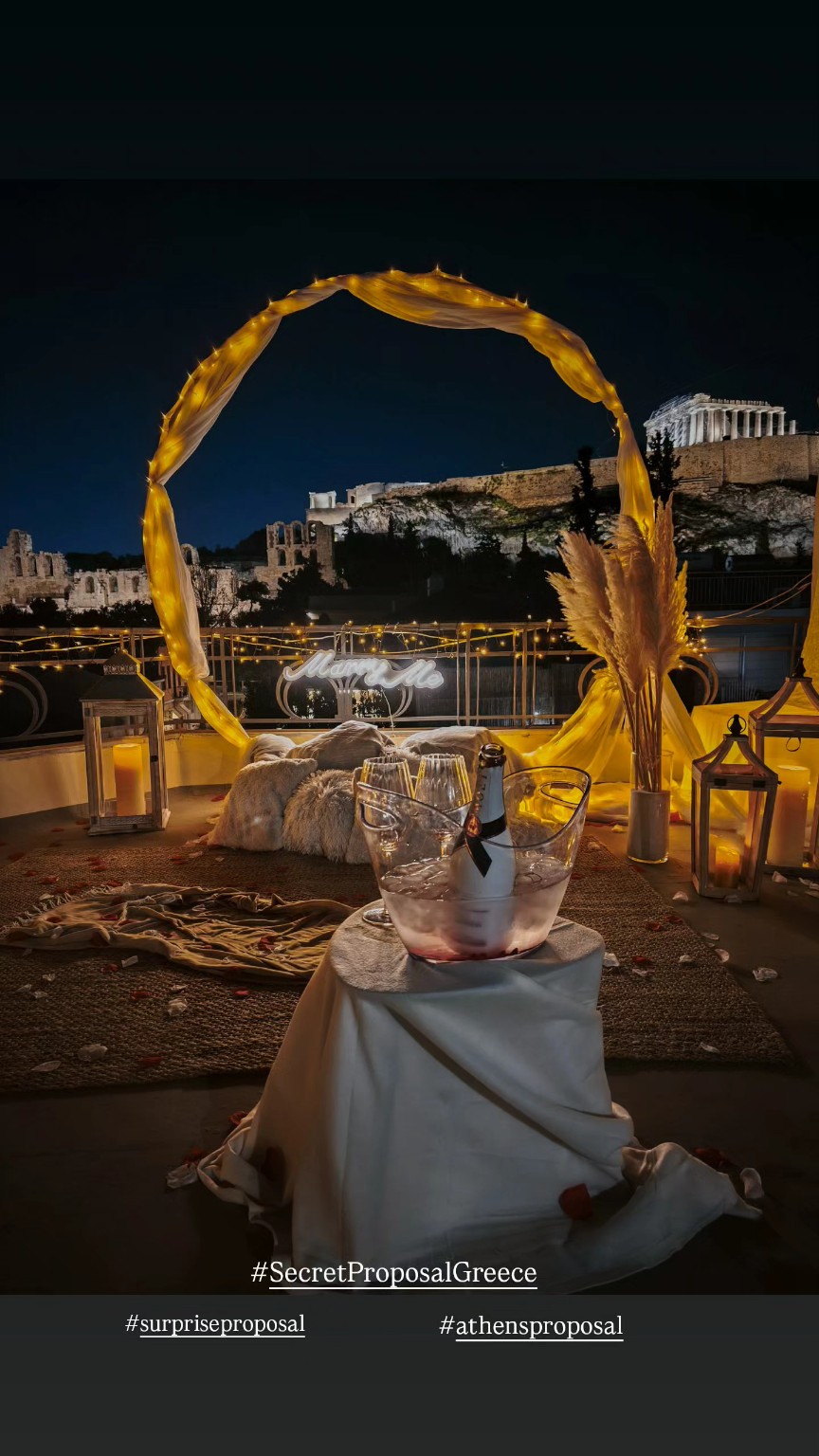
In Greece, an Acropolis sunrise can feel private and architectural, the Athenian Riviera gives an open sunset horizon, and an illuminated terrace turns the city into the backdrop after dark. On the islands, wind and transport timing matter as much as the view.
06 / DESIGN THE REVEAL BACKWARD
The arrival is the part most people forget.
Stand at the exact place where you plan to ask and work backward. Where will your partner first see the setup? Which direction will they face? Where will you keep the ring? What believable reason gets you there on time? Who gives the final signal?
A strong reveal plan includes one exact arrival point, one primary contact, a short cover story, a clear delay protocol and a backup that still feels intentional. Avoid overcomplicated instructions that require you to check your phone repeatedly in front of your partner.
When you kneel, turn slightly toward your partner instead of fully away from the camera. The image needs both expressions—not only the back of one person and the ring box.
07 / PHOTO & FILM
Document the truth of the moment without turning it into a production.
Share a recent photograph of both of you, your planned outfits, the arrival route and the exact reveal mark with the photographer. Agree on a signal, what happens if you arrive early or late, and whether the photographer should remain hidden or appear to be another visitor.
After the yes, allow a few minutes before directing portraits. The first embrace, disbelief, laughter and phone calls are often the most valuable part of the story. A short portrait session can follow once the moment has had room to breathe.
08 / WHAT TO SAY
Prepare the meaning. Do not memorize a performance.
Write three simple parts: what you love about your partner, the moment you understood you wanted a shared future, and the promise you want to make. Then ask the question clearly.
“This is what you mean to me. This is why I choose our future. Will you marry me?”
Use your own language, not a borrowed speech. Keep it short enough that you can stay present, and pause before opening the ring box if you want your partner to hear the words rather than seeing the answer first.
09 / AFTER THE YES
Do not let logistics rush the first minutes of your engagement.
Decide what follows before the day: champagne in private, portraits, a musician, dinner, a quiet walk or a call to family. Leave breathing room. The goal is not to move quickly to the next activity; it is to let the two of you understand what just happened.
THE FINAL CHECKLIST
Your proposal timeline at a glance.
WHAT IF GREECE IS NOT ON YOUR LIST YET?
Choose the proposal first. Let Greece become the reason.
Athens gives you ancient architecture, hidden neighborhoods, private Acropolis views and the sea within the same day. Santorini and the islands offer a slower rhythm and remarkable landscapes. The strongest Greece proposal is not built around a postcard—it uses the destination to amplify a story that already belongs to you.
Compare the best places to propose in Greece →